


In Seven Questions, we interview writers, editors, designers, and others in publishing. Today, we speak with Aisha Sabatini Sloan, a writer, curator, and artist. She joins us in the UNCW Department of Creative Writing this semester as a visiting professor of creative nonfiction.
Sabatini Sloan writes on race and current events, interweaving personal experience with analysis of art and pop culture. Maggie Nelson selected her second essay collection, Dreaming of Ramadi in Detroit, for the 1913 Open Prose Contest, and Graywolf Press recently released it in a revised edition. She has also won the CLMP Firecracker Award and the National Magazine Award for Columns and Commentary, as well as the Lambda Literary Award for Bisexual Nonfiction and the Jeanne Córdova Award for Lesbian/Queer Nonfiction for her essay “Borealis.” Sabatini Sloan is a recipient of the National Endowment for the Arts Literature Fellowship in creative writing, and her work has earned recognition in Best American Essays and Best American Nonrequired Reading. Her writing appears in the New York Times, the Paris Review, and Guernica, among many other places. Her essay “D Is for the Dance of the Hours,” originally published in Ecotone, is anthologized in Lookout Books’ Trespass: Ecotone Essayists Beyond the Boundaries of Place, Identity, and Feminism.
Lookout staffer Laurie Clark interviewed Aisha Sabatini Sloan in spring 2024.
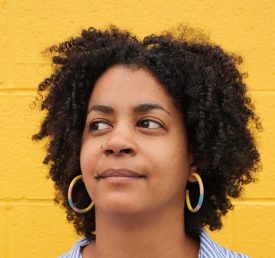 What do you look forward to experiencing while at UNC Wilmington?
Seeing everyone I’m in class with who are now like celebrities to me. Now that it’s spring, I’m excited to look at what people are growing, especially after hearing everyone in my class talk about their gardening adventures. Being in a warm place. The beach!
You grew up in Los Angeles, though you have family roots in Detroit, where you’ve also spent significant time over the years. How have these two different landscapes shaped your voice as a writer?
Detroit has a mythological dimension for me because it is where I encountered all of my most recently departed ancestors and where my parents met and had their artistic awakenings. My parents met at the public library in the late sixties. All of their friends were these children of the Great Migration or of immigrants who were rejecting war and charting a path into a larger world. Choreographers and musicians and Franciscans. The physicality of Detroit is so symphonic and grandiose, Diego Court at the DIA, the opera house—there is all this very old–world architecture. And my family is full of vivid storytellers. Whereas Los Angeles was all about possibility and newness. A futuristic place with beaches and skyscrapers and Hollywood and the cityscape is like holographic images floating in space. Being away from my family made me especially curious about it, which is where my writing started with this attempt to engage in this larger family myth-making endeavor. And even being in LA made me feel like I was far away from everything while also being in the center of something. My dad always talks about seeing things through a prism, and LA functioned a bit like that; it became this lens, a place through which I saw other places. And my writing has that tendency to look through things at other things and be nowhere and everywhere.
Continue Reading


 o agents do, why do they do it, and what does it take to get their attention? With an extended question and answer session, writers will have the opportunity to ask our panel of actively acquiring agents their most burning questions.


